.png)
Music copyright litigation stopped being a record-label problem in 2026. The cases have pulled in AI companies, a major university, restaurants, gyms, and any platform that touches audio. Here's the year in numbers, and what each numbers means if your business uses music in any form.
2026 in numbers
- $9 billion+ potential statutory damages after Sony and Universal expanded their case against Suno from 560 to 61,026 recordings, with a hearing scheduled for July 2026 as reported in Music Business Worldwide
- $3 billion sought by Concord, Universal Music Publishing Group, and ABKCO in their January 2026 lawsuit against Anthropic over 20,000+ scraped song lyrics, reportedly the largest non-class-action copyright suit in US history as mentioned in Resident Advisor
- 30,117 tracks Sony alleges Udio copied without permission to train its models, including songs by Beyoncé, Harry Styles, and Elvis Presley, reported in Variety
- $150,000 maximum statutory damages per song for willful copyright infringement under US law, reported by Cornell Law
- 13 separate infringement actions ASCAP filed against bars and restaurants in a single month in 2025, released by ASCAP press
- ~100 infringement cases BMI and ASCAP pursued combined in a year, concentrated in restaurants, bars, and fitness studios.
- $24,000 what one New Jersey restaurant was ordered to pay BMI after an investigator documented just four unlicensed songs played in a single evening.
- $400 million funding Suno raised in 2026 despite still facing active lawsuits, proof the AI-music economy is scaling right alongside the legal risk, reported by Music Ally
The common thread: every one of these cases traces back to someone (,a company, a school, a restaurant) using music (or a tool that generates it) without being able to prove clean rights to what's underneath it. Here's how that plays out by industry.
By vertical: who's exposed, and how
1. Universities & educational institutions
.png)
The case: Sony Music sued USC for using 170+ unlicensed sound recordings across 250+ social media posts. Tracks from Britney Spears, AC/DC, and Celine Dion used in promotional content. Sony sought up to $150,000 per song; the case settled in April 2026.
Why it matters: universities run hundreds of department and student accounts posting content daily. That's exactly the volume and unpredictability PROs and labels now go after.
The fix: default curriculum, department, and social content to cleared, royalty-free sources rather than whatever track is trending. Especially as more programs teach AI-for-media courses where students reach for whatever generator is free.
2. Creative SaaS & API platforms
The case: the underlying legal fight isn't about a platform yet, but the ground is shifting, courts are increasingly treating platforms as content providers, not neutral hosts, when their own embedded AI model generates the output. That shift can strip away liability protections platforms have historically relied on.
Why it matters: if you white-label or embed a third-party AI music engine into your product, the engine's training-data problem becomes your training-data problem. The Suno and Udio settlements show that "we'll license going forward" doesn't retroactively fix what a model already trained on.
The fix: before integrating any AI music API, confirm the vendor owns 100% of its training data outright: not just that it has "a licensing arrangement" in place.
3. Hospitality, fitness & retail (background music)
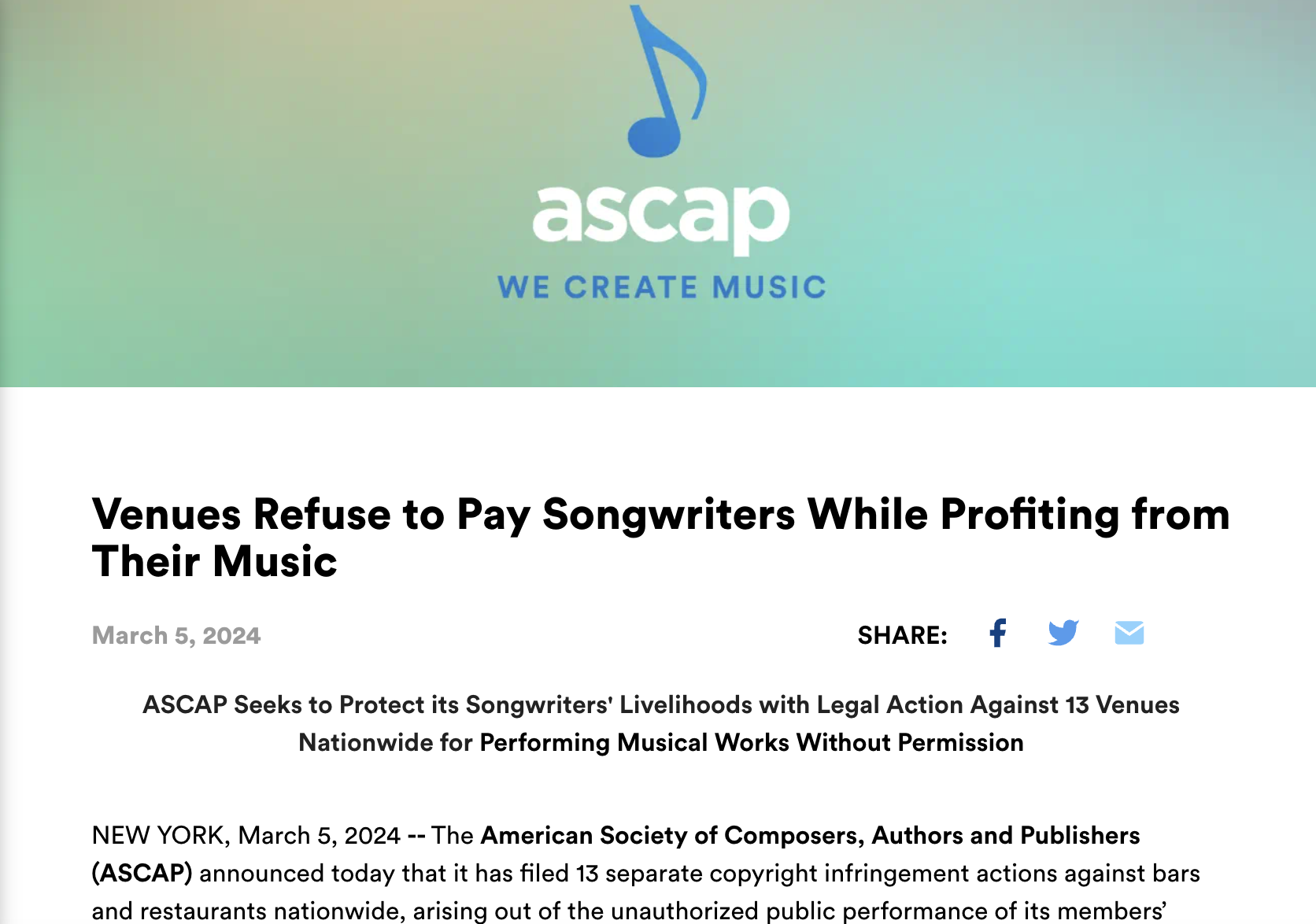
The case: ASCAP filed 13 separate suits against bars and restaurants in a single month in 2025; BMI and ASCAP combined pursued roughly 100 infringement cases that year, concentrated in restaurants, bars, and fitness studios. One NJ restaurant paid $24,000 after just four unlicensed songs were caught playing in one night.
Why it matters: background and ambient music is now one of the more actively, consistently enforced copyright categories, not a "we'll deal with it if it comes up" risk.
The fix: a flat-fee, royalty-free background-music system costs far less than a single PRO settlement, and removes the "loop fatigue" that comes with cycling the same licensed playlist on repeat.
4. Consumer hardware & telecom (bundled audio features)
The case: same platform-liability shift as creative SaaS, when courts stop treating a platform as a neutral pass-through for AI-generated content, the company doing the bundling inherits the exposure of whatever engine sits underneath.
Why it matters: if you're bundling an AI music feature into a device, OS, or subscription tier, you've effectively co-signed on your vendor's training data. If that vendor gets hit with an expanded suit (see: Suno going from 560 to 61,026 recordings in dispute), your product is downstream of that risk.
The fix: treat the AI music vendor's training-data ownership as a procurement requirement, the same way you'd vet any other IP-bearing component you ship inside your hardware.
The bottom line
"We didn't know the training data was a problem" stopped being a viable position in 2026, at every layer of the stack, the AI company, the platform that embedded it, the institution that posted it, the business that played it in the background. The businesses staying off next year's list aren't avoiding AI-generated music. They're the ones who checked who actually owns it before building anything on top.
If you want to learn about ways you can use SOUNDRAW to avoid these liabilities, check out our use cases below.